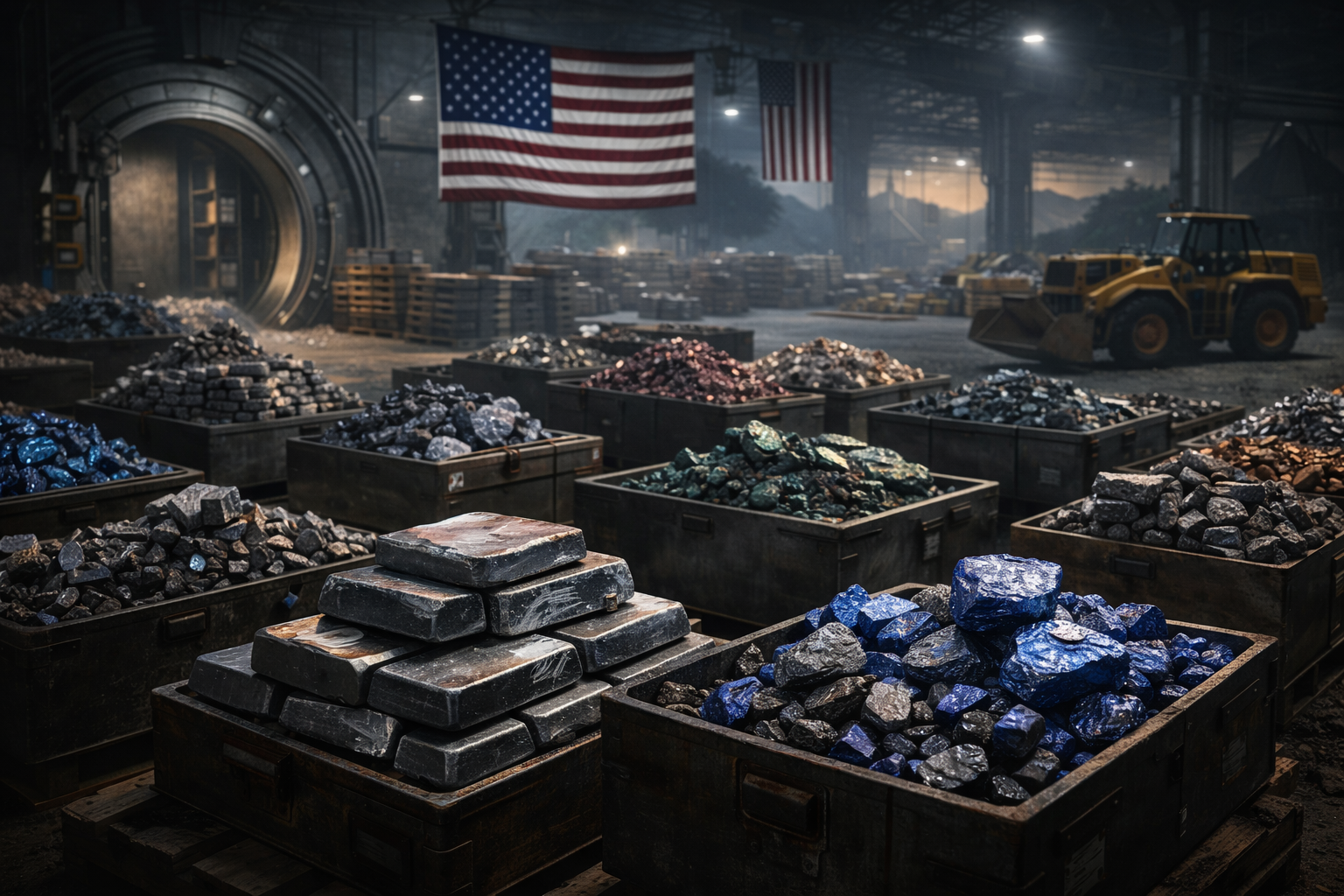
The United States is preparing to launch a strategic stockpile of critical minerals with $12 billion in seed funding, marking an unprecedented effort to protect manufacturers from supply disruptions and volatile commodity prices as Washington seeks to curb its dependence on China, Bloomberg reported on Monday.
The initiative, known as Project Vault, is expected to combine $1.67 billion in private capital with a $10 billion loan from the US Export-Import Bank, according to people familiar with the plan, the publication said.
The stockpile would procure and store minerals for automakers, technology companies and other manufacturers whose operations rely heavily on rare earths and critical metals.
If implemented, the project would represent the first large-scale stockpile designed specifically for civilian industries, extending beyond the US government’s existing reserves focused on defence needs.
A new model for securing supply chains
Project Vault is designed to mirror the logic of the country’s Strategic Petroleum Reserve, but with a focus on minerals rather than oil.
Materials such as gallium, cobalt and other rare earth elements would be accumulated to support industries ranging from consumer electronics to aerospace and clean energy.
The initiative underscores the Trump administration’s broader strategy to strengthen domestic supply chains and reduce vulnerability to geopolitical pressure.
China dominates the global supply and processing of many critical minerals, giving it significant leverage over downstream industries.
Recent export controls imposed by Beijing have highlighted those risks, prompting US manufacturers to reassess their exposure and, in some cases, scale back production.
Corporate backing and market interest
More than a dozen companies have joined the project so far, including General Motors, Stellantis, Boeing, Corning, GE Vernova and Google.
Commodities trading firms such as Hartree Partners, Traxys North America and Mercuria Energy Group are set to manage procurement for the stockpile.
The Export-Import Bank’s board is scheduled to vote on the proposed 15-year loan, which would be the largest in the institution’s history.
President Donald Trump is also expected to meet with GM chief executive Mary Barra and mining investor Robert Friedland on Monday, signalling the administration’s effort to align producers and consumers of critical minerals.
Senior officials involved in the planning said investor interest in Project Vault has been strong, with the initiative oversubscribed due to the creditworthiness of participating manufacturers and the backing of a federal export-credit agency.
How Project Vault would work
Under the proposed structure, participating companies would commit upfront to purchasing specific quantities of minerals at predetermined prices.
In return, Project Vault would procure and store those materials on their behalf, charging manufacturers fees to cover financing and storage costs.
Companies would be able to draw down their reserves as needed, provided they replenish the stockpile over time.
In the event of a major supply disruption, they could access their full allocations.
A central feature of the model is the requirement that manufacturers commit to repurchasing the same volume of materials at the same price in the future.
Officials believe this mechanism could help stabilise markets by dampening extreme price swings.
The project’s designers argue that such volatility poses a significant threat to corporate balance sheets.
Past episodes, including the sharp surge in nickel prices after Russia’s invasion of Ukraine, have shown how geopolitical shocks can rapidly disrupt global commodity markets.
Strategic and geopolitical implications
Project Vault reflects a broader shift in US industrial policy, with Washington increasingly willing to intervene in markets to secure strategic resources.
The administration has already invested directly in domestic mining and processing companies and signed cooperation agreements with allies such as Australia, Japan and Malaysia.
Further partnerships are expected to be discussed at an upcoming international summit in Washington, as the US seeks to build a network of supply chains less exposed to Chinese control.
The post US plans $12B critical-minerals stockpile to shield industry from supply shocks: report appeared first on Invezz